

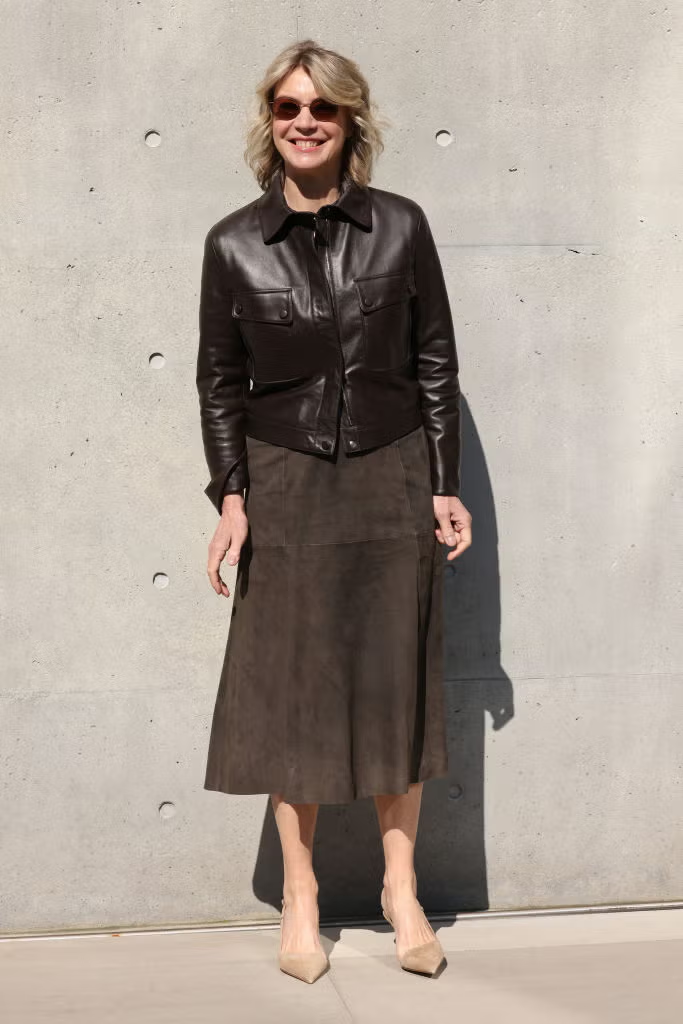


There is a particular fashion question that becomes more complicated with age.
Not “What should I wear?”
But:
“How can I look current without looking as though I’m trying to look younger?”
Because these are two very different things.
A woman in her fifties or sixties does not need to dress like a twenty-five-year-old to look modern. Nor does she need to abandon everything she loves every time fashion changes direction.
In fact, I would argue that the most stylish women over 50 have discovered something much more interesting:
Looking current has very little to do with looking young.
It is about looking intentional, relevant and in tune with the woman you are today.
And the good news is that you probably don’t need a completely new wardrobe to achieve it.
Sometimes, all it takes is a different proportion. A more contemporary shoe. A less predictable combination.
A handbag with a fresher shape.
A small change in how you tuck, layer or accessorise an item you’ve owned for years.
In other words:
You don’t necessarily need new clothes. You may simply need new ways of wearing the clothes you already have.
Let’s start here, because I think this distinction matters enormously.
There is nothing wrong with wanting to look youthful. But I don’t believe that youth should be the goal of getting dressed.
After 50, you have something much more interesting at your disposal: personal style with perspective.
You know what you like. You know what feels comfortable. You have probably learned which colours make you feel fantastic, which silhouettes make you feel confident and which trends you can happily ignore.
The objective, then, isn’t to erase your age.
📌📌 It is to make sure that your clothes don’t accidentally keep you trapped in an earlier version of yourself.
There is a difference between:
A modern wardrobe doesn’t have to shout “look at me!”
Often, it simply looks considered.
One of the biggest mistakes we can make when trying to update our wardrobes is assuming that individual garments have an expiry date.
They usually don’t.
A cardigan isn’t automatically dated.
A ballet flat isn’t automatically dated.
A straight-leg jean isn’t automatically dated.
A pearl necklace isn’t automatically dated.
A classic blazer certainly isn’t.
What can make an outfit feel dated is the way several elements are combined.
This is a subtle but important distinction.
Fashion changes through proportions, styling, colour combinations, accessories and silhouettes. Something you bought ten years ago can suddenly look surprisingly fresh when worn differently.
Try asking:
“How would I style this piece today?”
rather than:
“Is this piece still fashionable?”
That small change in perspective can save you a great deal of unnecessary shopping.
Take one item you haven’t worn for a while and style it in a completely different way.
Your familiar cardigan might suddenly look fresh with:
The garment didn’t change.
The context did.
If you want one styling lesson to take away from this article, make it this:
📌 Fashion often looks “new” because proportions have changed.
You don’t necessarily need to replace your clothes. You may simply need to reconsider the relationships between them.
For example, if you’ve spent years wearing:
fitted top + fitted trousers + small shoes
try experimenting with:
slightly relaxed top + wider trousers + more substantial footwear.
Or if you usually wear:
long tunic + slim trousers
try:
shorter jacket + high-waisted wide-leg trousers.
You don’t need to become a slave to oversized fashion. The point is simply to introduce a different silhouette.
This is one of the easiest ways to make a wardrobe feel more contemporary without buying an entirely new one.
When an outfit feels a little dated, don’t immediately replace the clothes.
First ask:
Could I change the proportion?
Try:
You don’t have to abandon classic style to look current.
In fact, classics are often the foundation of a sophisticated wardrobe.
The trick is to stop styling all your classics together.
A traditional blazer + traditional blouse + classic trousers + classic pumps + structured handbag can easily become a little too predictable.
Instead, introduce one element that changes the conversation.
Try your classic blazer with:
✅ Or take a very feminine blouse and pair it with something slightly more relaxed or masculine.
✅ Or wear your pearls with denim.
✅ Or your tailored trousers with flat sandals.
✅ Or a beautiful silk scarf with a very simple modern outfit.
This is one of my favourite principles of personal style:
The most interesting outfit is often created by allowing two different style languages to meet.
Classic + relaxed.
Feminine + masculine.
Polished + casual.
Minimal + expressive.
Elegant + unexpected.
📌 That contrast is what keeps a timeless wardrobe from becoming predictable.
If your wardrobe suddenly feels old-fashioned, look at your shoes.
Seriously.
Shoes have an extraordinary ability to change the perceived age and mood of an outfit.
The same pair of trousers can look completely different with:
This doesn’t mean that you need to throw away every pair you own.
Instead, experiment with changing the footwear before changing the clothes.
Your favourite straight-leg jeans may look completely different with a modern loafer than they did with the shoes you automatically wore with them five years ago.
Your midi skirt might feel fresher with a clean flat sandal.
Your tailored trousers might become considerably more relaxed with a sleek trainer.
And if comfort is important to you — as it should be — remember that comfortable does not have to mean visually old-fashioned.
The goal is not uncomfortable fashion.
It is comfortable fashion with contemporary proportions and details.
You know I couldn’t write an article for Bags & The Girl without talking about handbags. 😉
A handbag is often one of the quickest ways to update an outfit.
And you don’t necessarily need the latest designer “it bag”.
📌 Pay attention instead to:
👉🏼 If your outfit is already soft and relaxed, a more structured bag can add definition.
👉🏼 If you’re wearing tailoring, a softer bag can make the look feel less formal.
👉🏼 If your clothes are very neutral, an interesting bag can become the focal point.
And sometimes simply changing from a very small, rigid handbag to a slightly more relaxed contemporary shape can make an otherwise familiar outfit feel remarkably different.
Wear one of your favourite outfits exactly as you normally would.
Then change only the handbag.
Take a photograph before and after.
You may be surprised by how much difference one accessory can make.
This is one of the easiest — and most sustainable — wardrobe updates you can make.
Accessories have the power to change an outfit without changing your clothes.
Try experimenting with:
And don’t feel that every accessory has to match.
In fact, overly coordinated accessories can sometimes make an outfit feel more traditional than you intended.
Instead of asking:
“Do my shoes match my bag?”
try asking:
“Do these pieces belong to the same visual story?”
They don’t have to be identical.
They simply need to make sense together.
This is an important distinction.
Timeless does not mean unchanged.
A timeless item has enough simplicity, quality and versatility to move through different fashion moments.
A dated outfit, on the other hand, often reveals the exact moment in which it was styled.
Think about the difference between:
“This is a classic blazer.”
and:
“This is exactly how people styled a blazer in 2012.”
The first can remain beautiful for decades.
The second may need a little editing.
This is why I don’t recommend throwing away everything that was fashionable ten years ago.
Instead, identify the elements that are making the overall outfit feel anchored in a particular era.
Perhaps it’s:
Change one or two of those elements, and the entire outfit may suddenly feel more current.
This is especially relevant after 50, when comfort often becomes a much more important consideration.
There is absolutely nothing wrong with wanting clothes that move, breathe and feel good.
But if every part of an outfit is oversized, soft and unstructured, the result can sometimes feel less polished than you intended.
Instead, think about balance.
If your trousers are wide and fluid, perhaps your top has a little more definition.
If your shirt is oversized, perhaps your trousers are more streamlined.
If your dress is loose, perhaps your accessories provide structure.
If your jacket is boxy, consider showing a little wrist, ankle or neckline.
You don’t need to expose more of your body to create definition.
You simply need to create visual structure.
Another wonderful way to make familiar clothes feel new is through colour.
And this doesn’t mean suddenly wearing neon.
Sometimes a small change is enough.
Try taking a familiar neutral — navy, camel, ivory, grey, chocolate brown or black — and introducing one colour that feels a little less expected.
Or experiment with tonal dressing.
For example:
You can also use colour through accessories.
A colourful handbag, scarf, shoe or pair of earrings can transform a neutral outfit without requiring a new wardrobe.
And if you’ve already discovered your most flattering colours, this is where colour analysis becomes particularly useful: you don’t need to follow every colour trend when you understand which colours actually make you look and feel your best.
There is something else I want women over 50 to reconsider.
We are constantly told to wear clothes that are “flattering”.
Of course, we want clothes that work with our proportions.
But there is a danger in treating flattering as the only objective.
❌ An outfit can be flattering and boring.
❌ It can be flattering and dated.
❌ It can be flattering and completely disconnected from your personality.
✅ What if we added a few more questions?
Does this feel like me?
Does it feel current?
Does it express something about my personality?
Would I choose this if nobody told me what was “flattering”?
Because personal style is not a mathematical exercise in hiding and disguising.
It is communication.
Your clothes tell the world something about you before you say a word.
After 50, I think that message can become more interesting than ever.
If your wardrobe feels stale, don’t immediately go shopping.
Give yourself a wardrobe remix challenge instead.
Choose five pieces you haven’t worn recently.
Then create three completely different outfits from each.
For example:
Look 1:
White shirt + wide-leg trousers + belt + loafers.
Look 2:
White shirt worn open over a simple tank + jeans + sandals.
Look 3:
White shirt + midi skirt + statement earrings + contemporary bag.
You have not bought anything.
But you have created three new outfits.
Do this with your:
🧥 favourite blazer;
👖 jeans;
🧥 cardigan;
👗 dress;
🧍🏻tailored trousers;
🥼white shirt.
You may discover that what your wardrobe actually lacks isn’t more clothes.
It may simply lack new combinations.
Before buying something new — or deciding that something you own is hopelessly dated — ask yourself:
That last question is particularly useful.
Because sometimes an item isn’t objectively outdated.
You’ve simply outgrown it.
And that’s okay, too.
Not by dressing younger.
Not by copying women half your age.
Not by buying every new trend.
Not by throwing away everything in your wardrobe.
And certainly not by following a list of arbitrary rules about what women over 50 “should” or “shouldn’t” wear.
Instead:
Update your proportions.
Refresh your footwear.
Reconsider your accessories.
Introduce a little contrast.
Experiment with colour.
Mix classic pieces with something unexpected.
Look at your outfits rather than individual garments.
📌 And most importantly:
Keep the parts of your style that still feel like you — and update the parts that no longer do.
Because getting dressed after 50 shouldn’t be an exercise in trying to turn back the clock.
It can be something much better.
It can be about finally having enough confidence to stop dressing for the woman you used to be — and start dressing for the woman you have become.
If your wardrobe has been feeling a little “stuck” lately, don’t start by asking what you need to buy.
Stand in front of your wardrobe and ask a different question:
“How can I make what I already own feel like me — now?”
You may be surprised by the answer.
Alwas take good care of yourself, stay stylish, and true to yourself! ❤️
Yours
Agnese K
We use cookies to improve your experience on our site. By using our site, you consent to cookies.
Manage your cookie preferences below:
Essential cookies enable basic functions and are necessary for the proper function of the website.
These cookies are needed for adding comments on this website.
Statistics cookies collect information anonymously. This information helps us understand how visitors use our website.
Google Analytics is a powerful tool that tracks and analyzes website traffic for informed marketing decisions.
Service URL: policies.google.com (opens in a new window)
Marketing cookies are used to follow visitors to websites. The intention is to show ads that are relevant and engaging to the individual user.
You can find more information in our Cookie Policy and .